  |
 Welcome
to Wilseyville Homeowners Association homepage Welcome
to Wilseyville Homeowners Association homepage
Welcome to the Wilseyville Homeowners Association homepage. Although it is designed mainly for the use of its members, we are happy to share with our website visitors the history of our Association as well as our accomplishments and activities that benefit our membership, our township, our neighboring communities, and our county at large.
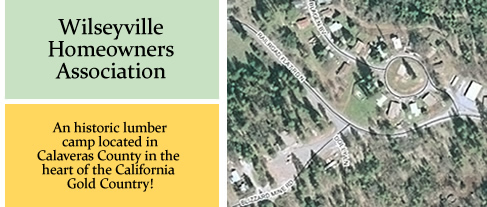
The township of Wilseyville was named for H. Lawrence Wilsey, Sr., who, in 1940, through a San Francisco-based company, American Forest Products, opened a lumber mill in what was then called Sandy Gulch, which geographically is located between the townships of West Point and Glencoe in Calaveras County.
The Wilseyville Mill was once bustling with activity; and in 1942, under the direction of then General Foreman, Howard Blagen, 28 little cottages were built along the upper ridge of the Wilseyville mill camp to house those lumberjacks and mill workers with families. A large dormitory and 12 very small cabins (each containing two bunks, a table and two chairs and a small wood stove) were built to house the single men who worked in the mill. A company store (commissary) provided a local source for gas, food and dry goods; and a two-storey Town Hall provided a site for entertainment for the mill workers and their families. A newsletter called “The American Eagle” kept folks informed about the goings on at the mill. Mill activities, Births, weddings, anniversaries and other milestone events were reported, along with humorous cartoons, great photos, recipes, and the goings on at other American Forest Products mills throughout California.
Only after the mill closed in 1969 did the camp and surrounding township suffer hard times. The camp, comprised of 44 acres, went up for sale as a single parcel for $100,000, but there were no takers. Finally, in 1975, several residents put into motion the subdividing of the mill camp into 29 parcels. The parcels were then sold at the bargain price of between $2,600 and $4,200, depending on the square footage of each little cottage. The company store was sold separately for $10,000. Soon after that, the residents formed the Wilseyville Homeowners Association (WHA) governed by five elected board members. The Town Hall, located on Upper Lot 30, became the centerpiece of the “common land” owned jointly by Association members. Twenty-eight garages were later constructed at each end of the camp and were assigned to each residence. The Association also approved construction on its common land of a building that serves as a satellite station for the West Point Fire Department. Several Wilseyville Camp residents are volunteer firefighters.
Today, this little village is known as the “Historic Wilseyville Camp.” Annually, a newly elected board governs the business activities of the WHA. Meetings are held quarterly in the Wilseyville Fire Station at the entrance to the camp and the little classics library/community museum can be seen from the County Road that runs along the western side of the camp between Blue Mountain Road and the Tom Taylor Bridge along Rail Road Flat Road. The Company Store (commissary) was recently purchased by a long-time resident of Wilseyville and will be reopening in the summer or fall of 2010. And, although the Town Hall is only a faded memory at the present time, plans are in the works to re-build it to its original design on the same foundation it once proudly rested upon before it was sadly destroyed by fire in the early 70s.
The poem on this website was written by Marcia Adams, who lived in the Camp as a young girl. It describes the Camp in its hey day, with each cottage surrounded by a picket fence and a circle park for the many children, who, like Marcia, grew up in the Wilseyville Camp. Another of her poems is displayed at the Wilseyville Classics Library, #1 in the Camp, which is open to the public most weekends “whenever the American Flag is out.”
|